Dear sales managers, are you leaving 25% revenue growth on the table?

Alvin Kantapura
CEO
Product
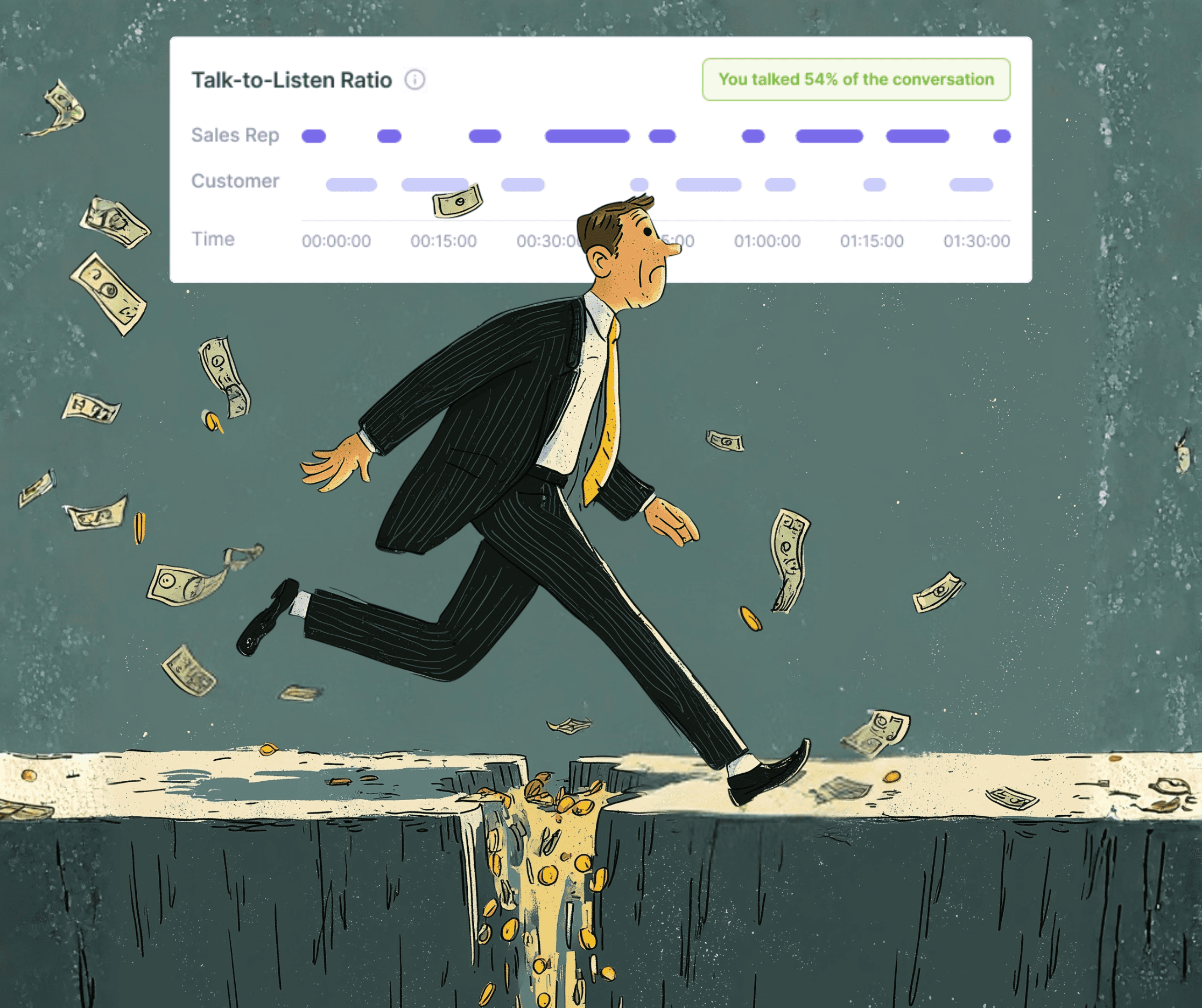
It’s common practice for CMOs to analyze marketing campaigns down to the last detail to understand how to optimize spend for maximum performance. There’s a whole science behind this in digital marketing.
Yet the same discipline is missing in sales.
At best, a sales manager diligently reviews the deal conversion pipeline:
→ Sales cycle
→ Win rate
→ Lead quality score
That leaves a massive blind spot in the middle—from discovery meetings → pitches → negotiations. Insights buried within these meetings determine the outcome of the deal.
For companies doing over $2M ARR with a 20% win rate, improving that win rate by just 5 percentage points can add $500K to Annual Recurring Revenue (ARR).
25%!!!!! 🤯
Let that sink in.
So once you’ve figured out:
→ Lead generation
→ Product–market fit
The next growth lever shouldn’t be more pipeline.
It should be win rate, by optimizing how your sales reps pitch.
That starts by measuring performance to spot gaps.
These are the top three metrics we watch closely in our sales process—and you should too.
——
The best salespeople don’t sell. They solve problems.
You can’t solve problems without understanding pain points.
To uncover real pain, great salespeople ask great questions.
Like detectives, they dig deeper and deeper until they reach the problem behind the problem.
Once the real issue surfaces, selling becomes simple. It’s just the art of matching your solution to that problem so the customer clearly sees the value.
Here’s a real example from a sales pitch I had last week.
A potential customer started pushing hard on pricing.
👨🦱 - Customer: “You’re new in the market. You can use us as a case study. Come on—you can give us a better price.”
Instead of giving in, or slipping back into pitch mode and repeating our selling points, I asked a simple question.
👱🏽♂️ - Sales: “Why are you buying our product? What does it do for you?”
👨🦱: He paused, then said, “well… it will help us measure customer satisfaction and upsell a new product line.”
👱🏽♂️: I followed up with another question. “Potentially, what would that revenue uplift be worth in a year’s time?”
👨🦱: “Roughly about $1M,” he said.
👱🏽♂️: “You’re spending $5K to make $1M, that’s more than worth the return.” I replied.
The price negotiation ended there.
A good question can completely reframe the conversation.
I believe the real job of a salesperson isn’t to convince—it’s to ask the right questions, uncover the real problem, and clearly articulate how their solution adds value.
When you do that well, selling happens naturally.
To measure this, we introduced a metric called Talk-to-Listen Ratio 🗣️/👂.
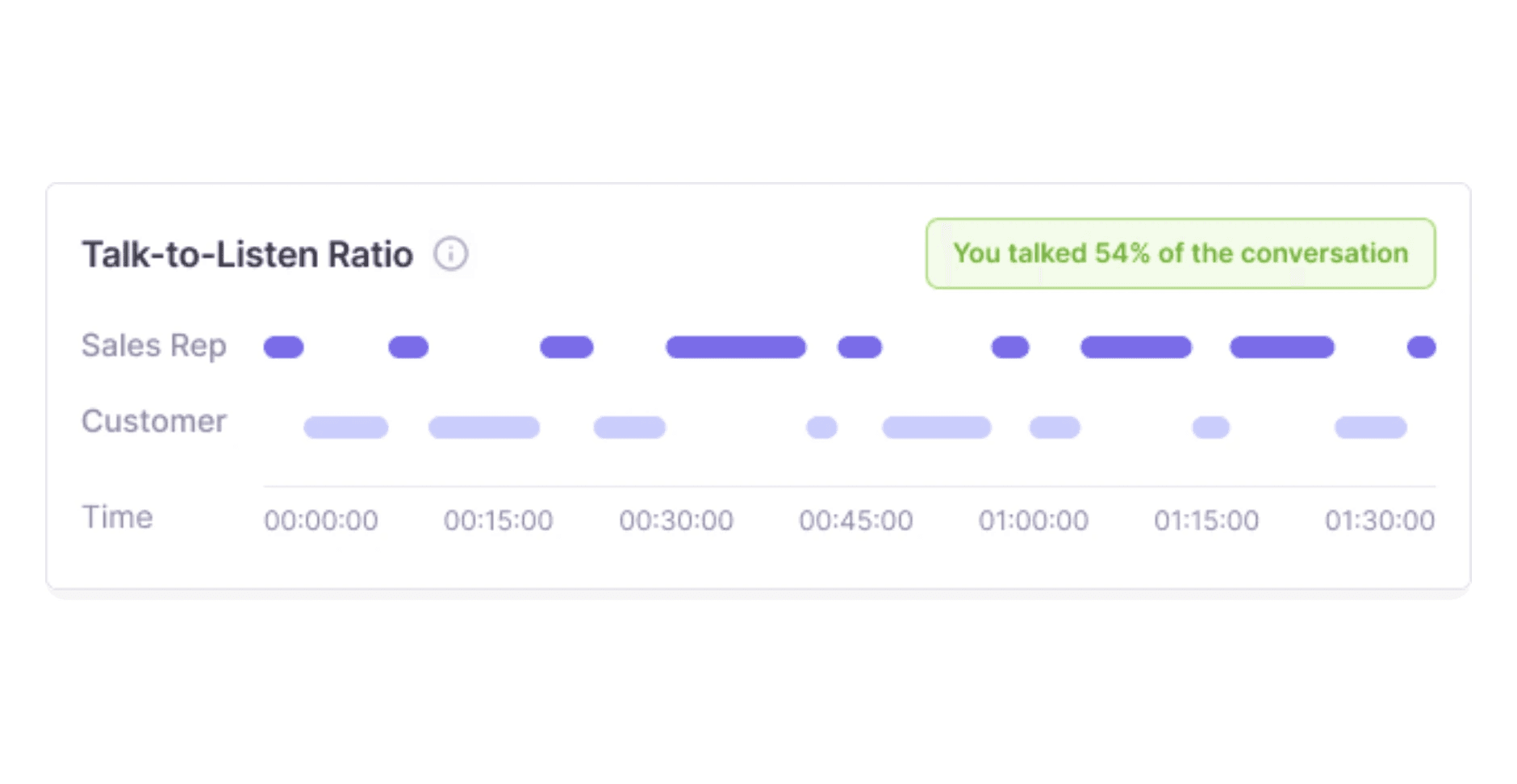
It analyzes the entire conversation and breaks down speaking time between the sales rep and the customer.
In one snapshot, you can see whether your rep is:
→ Talking too much
→ Being too quiet
→ Or maintaining a healthy back-and-forth with thoughtful questions
Strong rapport increases the likelihood of conversion because customers feel understood. Their problems are acknowledged.
——
You’ve got an hour ⏳. Spend it wisely.
Most pitch meetings last an hour. It’s a race against time.
Can you be convincing enough in that hour to earn the next meeting?
It depends entirely on how you use it.
Some reps bombard customers with facts and selling points, afraid they won’t get another chance to say everything.
Others drift into endless small talk—chit-chat here, playful banter there. No clear agenda. Everyone leaves feeling the meeting went nowhere.
And then there are those who do it right.
They start with light rapport-building, move into thoughtful questions to explore problems, tie those problems back to their solution, and close with clear, actionable next steps.
Those are the ones who close deals.
Knowing how your team spends time in a meeting gives you a powerful coaching advantage.
Instead of vague advice like “don’t spend too much time being playful,” you can point to specific timestamps where time was wasted—or where something critical was missing.
I once had a sales rep who was lagging behind her peers.
She knew the product well. She communicated clearly. On paper, everything looked fine.
I couldn’t figure out why she wasn’t closing.
So I joined one of her meetings and watched her pitch live.
90% of the meeting was excellent. She built rapport, asked good questions, positioned the product well.
But she missed one thing: clear next steps.
She was afraid of overreaching. Afraid to ask for commitment. Afraid to close.
Once we identified that, we worked on changing her mindset and closing behavior.
Within weeks, her results took a completely different trajectory.
Sometimes it’s a small missing piece that makes all the difference.
But as sales managers, we can’t attend every meeting.
That’s why we built Conversation Segment metrics—to break conversations into labeled chunks so managers can understand the entire meeting in one glance.
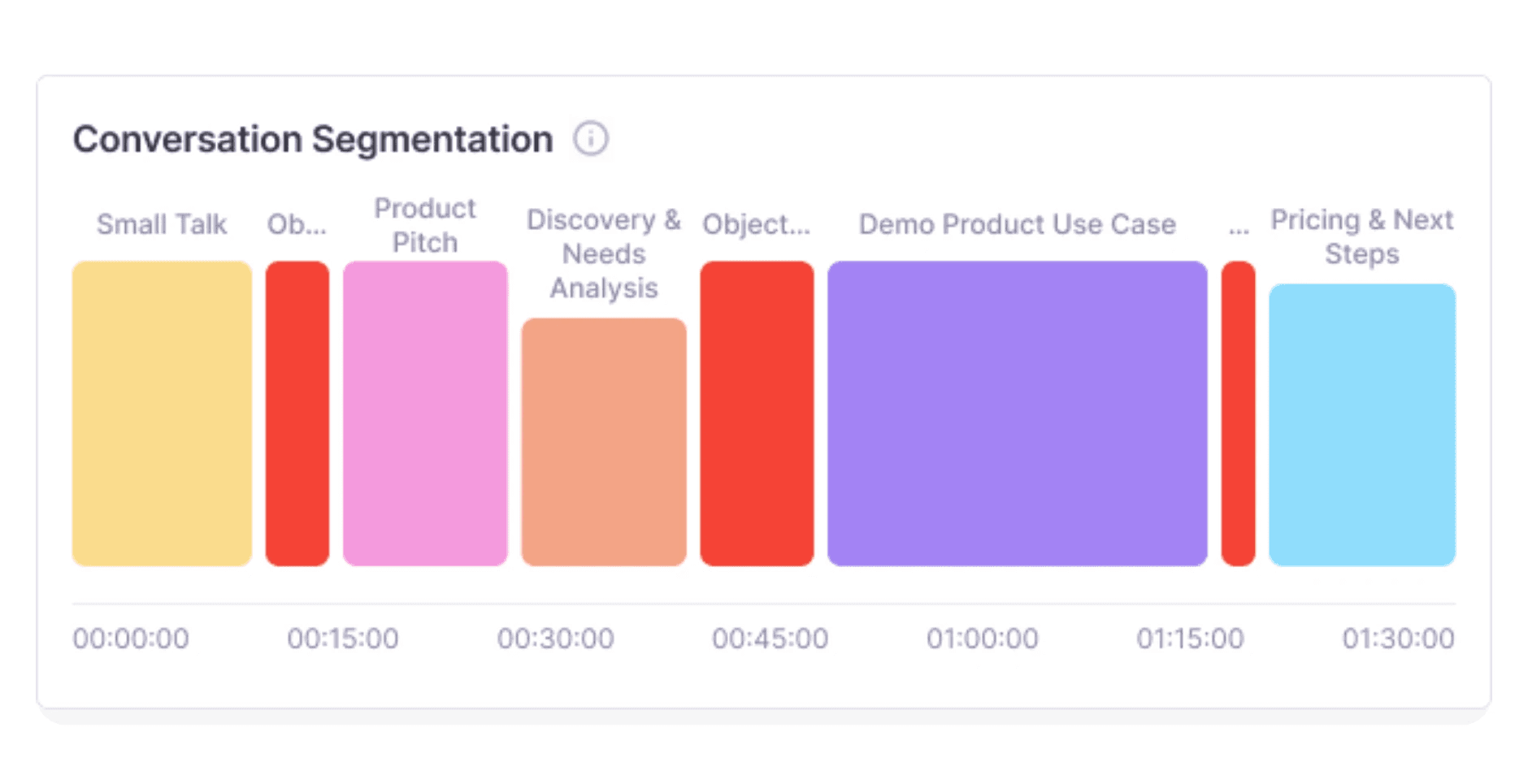
See where reps are spending their time.
See what’s working—and what’s not.
Jump directly to the segments that matter.
Maybe the customer spent 15 minutes pushing back on pricing.
That’s the part you want to listen to. It’ll show up on the segment, just click play there to listen only to that chunk.
Don’t spend your entire work week just playing back meeting audio.
Listen only to the moments that drive better coaching and better outcomes.
——
Stop 🤚 guessing. Your customer is telling you what to fix.
B2B sales conversations are goldmines for insight.
Customers are always giving feedback.
If they think the price is too high, they’ll tell you.
If the product misses the mark, they’ll tell you.
If budget is an issue, they’ll tell you.
As sales managers, our job is to listen and adjust.
But most teams don’t have a systematic way to capture this feedback.
Instead, we rely on second-hand insights from sales rep.
It becomes a challenge to discern noise from signal.
So decisions slow down.
That’s when targets get missed.
To solve this, we created Objection Ranker 🛑 metrics.
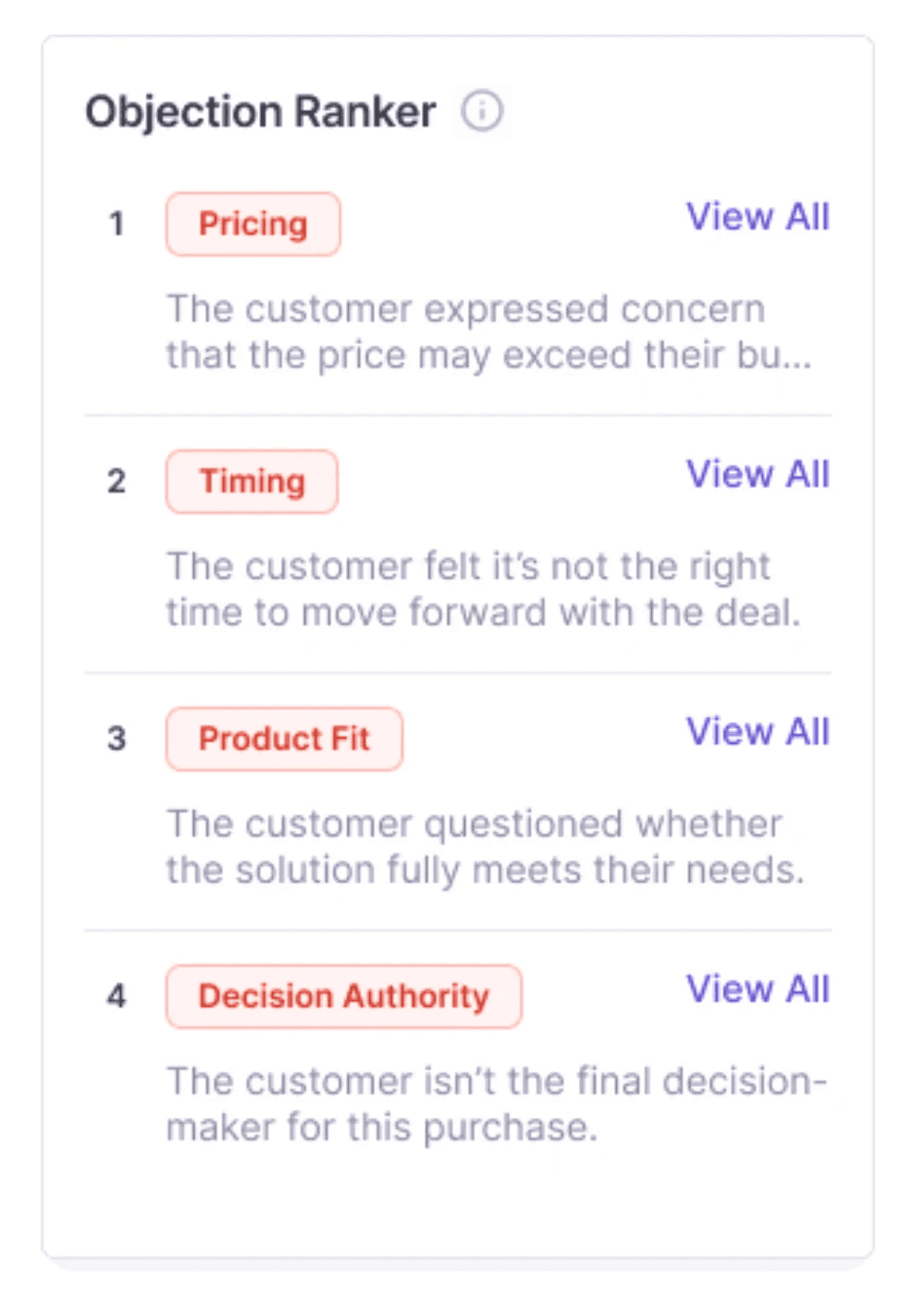
It automatically ranks customer objections from most to least discussed within a meeting.
When you aggregate this across reps and time periods, patterns become obvious.
Managers can quickly see where the real problems are—and fix them faster.
—
We believe, with strong conviction, that B2B sales is ready for a massive level-up.
With insights captured seamlessly—without forcing reps to write longer CRM logs—managers can react faster, coach better, and help teams beat their targets with less guesswork.
If you’re interested in becoming a pioneer organization using this approach to win more deals, book a meeting with me here and let’s talk: https://calendar.app.google/K56AZCxE3iVVCqwE7